Damscene plums
5th century Roman Britain

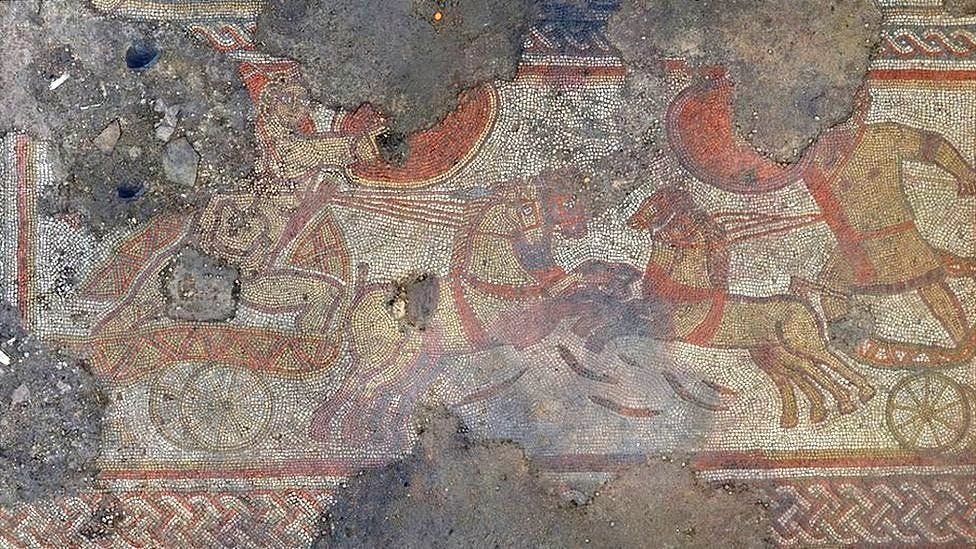
Achilles and Hector fight to death in the Trojan war - a mosaic recovered from a field in Rutland.
The Menu
Duck with plum sauce
Bread
The Music
Echoes of Ancient Roman – Michael Levy
The Time
Empire’s do not tend to disappear with a bang, but with a long drawn-out whimper. The Roman empire was no exception. After reaching its greatest extent in the first century A.D., it experienced a slow decline, through territorial losses its colonies became increasingly isolated until eventually, they were abandoned. The Roman’s had transformed Britain over four hundred years, and like all of Rome’s colonies, it had its own distinct flavour. Three million people were ruled over by a hundred thousand Roman soldiers and their families. Unsurprisingly, they were not immune from the local influences and many of those who arrived bearing the Roman imperial standard stayed, building estates and houses, which included some of the incredible mosaics which are still being turned up today.
But perhaps the most enduring impact the Romans had on Britain was what we eat. Pre-Roman recipes haven’t survived (the Druids had strong ideas about what should be written down), but from the food trapped in iron age teeth we know that milk, legumes and oats featured heavily. And what have the Roman’s ever done for us? They introduced an extensive array of fruits, vegetables and animals to eat, including guinea fowl, pheasants, fallow deer and, less edible, cats. Bread was transformed – the celts frequently ate ‘black bread’, made from a range of cereals with added animal blood. The animals who supplied the blood were not killed, but let from, and the wounds were then cauterised to prevent infection and keep them alive. The Romans were not the first to bring new foodstuffs on the British isles, the Celts (another lot of European interlopers) had brought with them cattle and wheat, but by the time the Roman’s turned up, their innovations had been spread far and wide on the island and become naturalised.
The ancient history of Britain is far from the story of one lone race toiling it out in the wet and cold on their own before they conquer the world. It’s a history of absorption and appropriation – picking and choosing from those who came, decided they rather liked the place and hung around, eventually forgetting that they’re just as foreign as the next lot.
The Cooking
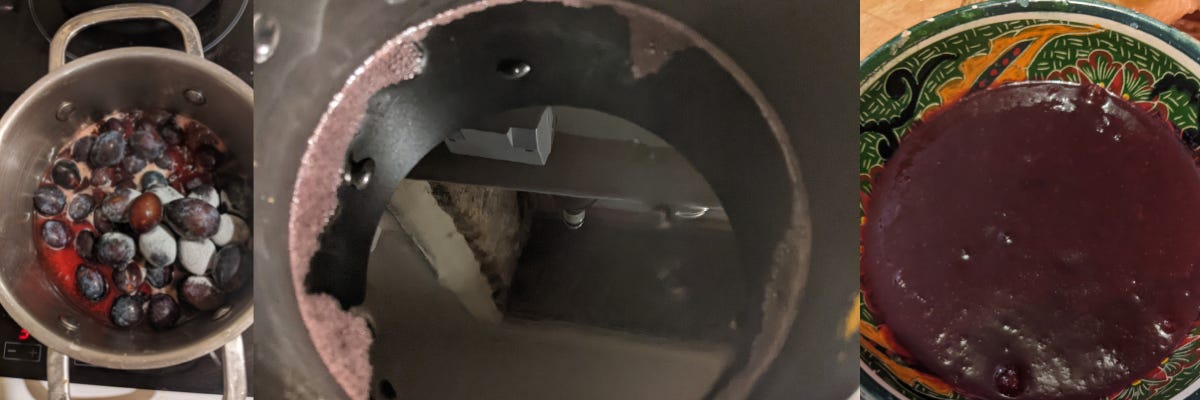
Our meal today is a combination of local British produce and distinctly Roman dishes. Ducks and geese were here before the Romans and were also widespread in Europe. Their bones turn up at almost half of Roman archaeological sites, even if they make up a small proportion of the animal bones uncovered. The recipe for our central dish, a simmered and roasted duck served with a damson sauce, comes down to us from the 1st century culinary mastermind Apicius, whom we shall be revisiting in style at the end of our culinary journey through the centuries.
We conveniently have access to damsons due to some extremely productive damsons trees on the Yorkshire farm, but it seems that what we now called damsons – a kind of very sour plum, for the uninitiated – are probably rather different to what the Romans thought of as damsons, which we’re supposedly extremely sweet and originated from near Damascus (‘damascene plum’). The plums were stewed, strained, and flavoured with honey, pepper and cumin – so far, so Roman.
Simmering the duck before roasting it has the benefit of helping render the fat from the duck, with the roasting then providing additional toothsomeness through the Maillard reaction (i.e., browning).
The Eating
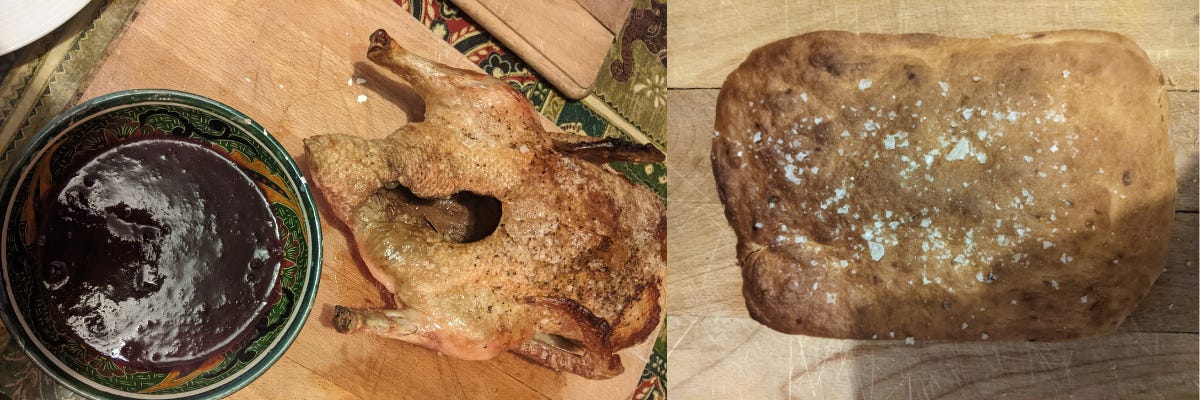
Simmered and roasted duck with a piquant fruit sauce and soft bread is an uncomplicated and delicious combination. One can just about imagine Romans ambling home from a night of dressing up like a bull at the Temple of Mithras to enjoy a hearty meal cooked up by a compliant but secretly rather rebellious slave, and we felt our meal successfully channelled this, despite the lack of bovine centred ritual.
The Cleanup
While excellent there was, however, one issue with our meal – we fell down a trap of anachronistically using butter beans in the planned side dish, quite an interesting herb and oat combination. Some short-sighted research had landed us on a recipe which used butterbeans, when in fact the herb and oats essentially form a sauce, but we have no idea what the sauce was meant to dress. Butter beans are sadly very much not Roman, originating from the Americas and not to be seen on these shores for another thousand years after our meal.